
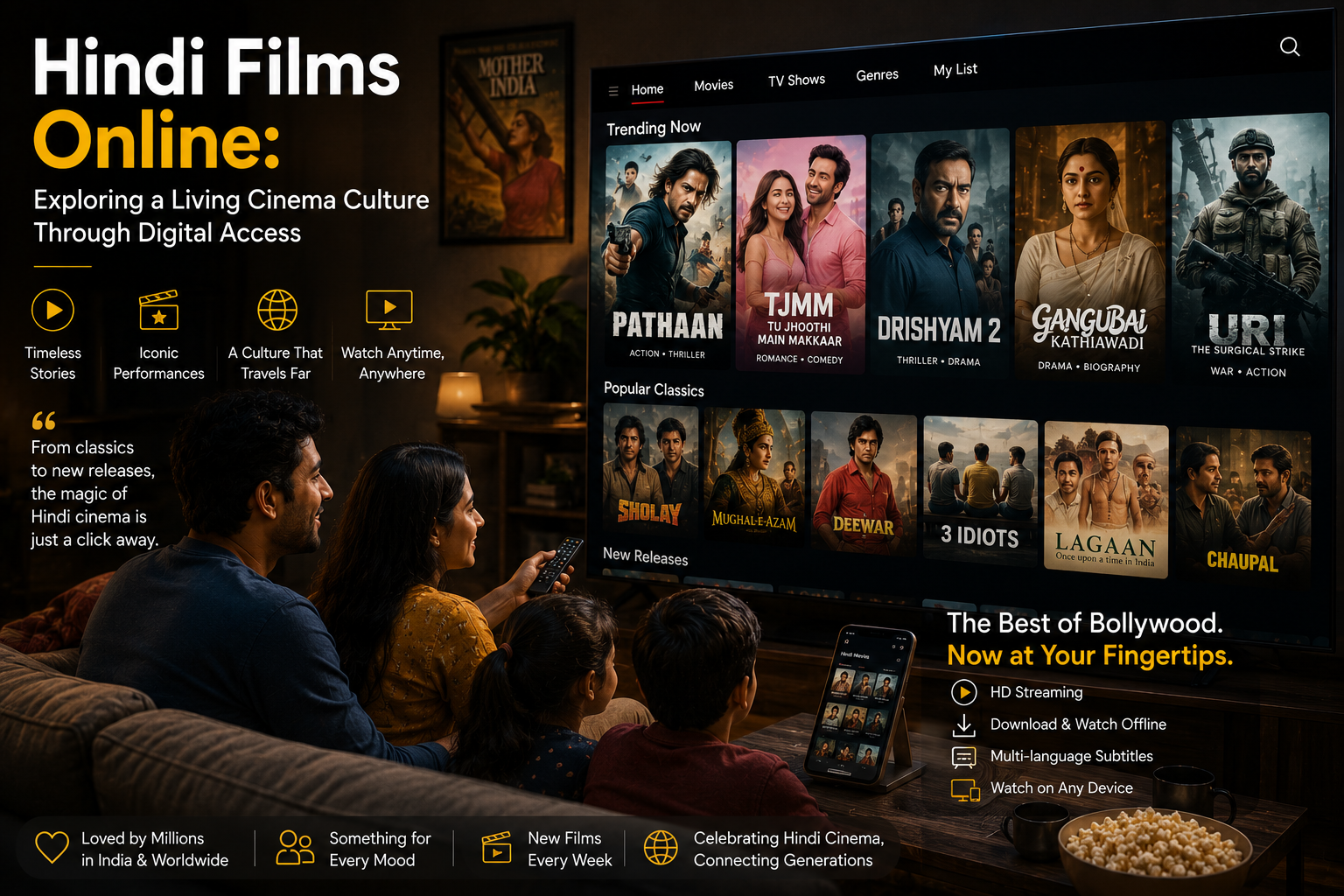
Hindi cinema occupies a distinctive position in India’s entertainment landscape. It combines a long theatrical tradition with a rapidly evolving digital ecosystem in which audiences can discover films through connected devices, online catalogs, and on-demand services. The contemporary Hindi film audience is therefore no longer defined by cinema halls or television schedules alone. For viewers interested in हिंदी फिल्में ऑनलाइन देखें, digital access offers a convenient way to explore the breadth of Hindi-language entertainment while choosing when and where viewing takes place.
The Hindi Film Audience Is Changing
The modern Hindi film audience is increasingly connected to digital media before, during, and after the viewing experience. Film discovery can begin on social networks, video platforms, search engines, entertainment publications, or streaming catalogs long before a viewer actually presses play.
Research from Ormax Media’s 2026 Bollywood Audience Report provides an interesting picture of this behavior. The study estimates that the regular urban Hindi theatrical audience aged 15 and above is around 28.5 million, while also highlighting the strong participation of younger viewers in cinema consumption.
This illustrates an important point about contemporary Hindi cinema: theatrical viewing and digital entertainment are not necessarily competing habits. Audiences can move between cinemas, television, smartphones, connected televisions, and online catalogs according to the situation.
Streaming consequently becomes another part of the Hindi film ecosystem, providing access when a theater visit is inconvenient or when viewers simply prefer the privacy and flexibility of home entertainment.
Beyond the Conventional Bollywood Image
Hindi cinema is often reduced internationally to the word Bollywood, but the broader Hindi-language catalog is much more varied. Commercial entertainment exists alongside drama, comedy, romance, crime, thriller, family cinema, historical productions, fantasy, and other formats.
This diversity is particularly noticeable when audiences explore a digital catalog rather than relying on a television schedule. A broadcaster has limited hours and must make programming decisions in advance. An online catalog can accommodate far more choices simultaneously.
For viewers, that means the search for entertainment can begin with a mood rather than a specific title. Someone may want a light comedy, while another viewer may prefer suspense or drama. Genre-based shelves and intuitive categories make it possible to move toward those preferences without scrolling through an unrelated collection.
The catalog therefore becomes part of the discovery experience. It does not simply contain Hindi films; it provides a structure through which audiences can understand and explore them.
From Theatrical Release to Digital Discovery
The traditional life of a Hindi film often began with theatrical distribution, followed by television and eventually physical media. Digital platforms have introduced a much more flexible sequence.
The relationship between theatrical releases and streaming has become particularly important in India. Research into India’s post-theatrical rights market shows that major streaming services continue to compete for film libraries and digital rights, reinforcing the connection between cinema and online distribution.
For audiences, this means that a film can continue its journey after leaving theaters. Viewers who could not attend a local screening may eventually encounter the same production online, while international audiences can gain access where theatrical distribution may have been limited.
This is particularly valuable for Hindi cinema because its audience extends far beyond India’s borders. Digital distribution provides a practical way for viewers in the Gulf, Europe, North America, Southeast Asia, and other regions to remain connected with Hindi-language entertainment.
Why Digital Catalogs Encourage Exploration
One of the greatest advantages of online cinema is the ability to browse without a fixed destination. A viewer does not necessarily need to know the exact title they want before opening a streaming platform.
Categories, search functions, curated shelves, recent additions, and other organizational tools create multiple routes into the catalog. A viewer can search directly for a known title or simply explore until a suitable option appears.
This changes the psychology of movie discovery. Traditional television encourages passive selection because the schedule determines what is available. Digital catalogs encourage active exploration because the audience controls the path through the collection.
For Hindi cinema, where the range of available genres and production periods is extensive, this flexibility can reveal films that might otherwise remain outside a viewer’s immediate awareness.
The Importance of a Frictionless Viewing Journey
The quality of a streaming service is not determined solely by how many films it contains. The journey from discovering a title to starting playback is equally important.
If viewers encounter repeated registration requests, unnecessary redirects, or intrusive pop-ups, the convenience of online entertainment quickly disappears. A large catalog becomes less useful when access to it feels complicated.
Moviewala takes a more direct approach. Viewers can browse the Hindi catalog, select a title directly from the shelf, and move toward playback without a mandatory registration wall. The absence of annoying pop-ups keeps the interface focused on entertainment rather than interruptions.
This direct model is particularly useful when browsing several possibilities. Viewers can open a title, return to the shelf, explore another category, and make a decision without repeatedly passing through unnecessary steps.
The experience becomes closer to browsing a personal digital collection, with one important difference: the catalog remains immediately accessible online.
Hindi Cinema Across Different Screens
The modern Hindi film audience is increasingly device-independent. Smart televisions remain an important choice for home viewing, but laptops, desktop computers, tablets, and smartphones have become equally relevant parts of the digital entertainment environment.
India’s broader media market reflects this multi-screen transformation. A recent Ministry of Information and Broadcasting industry report describes a hybrid video ecosystem in which television, connected TV, mobile devices, and online platforms increasingly coexist.
For Hindi cinema, this flexibility means that the viewing environment can change according to the circumstances. A viewer may use a Smart TV for a longer evening session and a smartphone for more casual browsing.
The platform therefore needs to maintain a consistent interface across different screen sizes. Content shelves should remain visually clear on a television while navigation and playback controls need to remain practical on mobile devices.
When this works correctly, changing screens does not change the basic experience.
The Technology Behind Stable Hindi Streaming
Streaming a modern film requires much more infrastructure than the simple appearance of a play button suggests. High-resolution audiovisual files need to travel efficiently from servers to viewers while adapting to different devices, connection speeds, and geographic locations.
Cloud infrastructure and content delivery networks help distribute media efficiently. Modern compression reduces the amount of data required to transmit detailed video, while adaptive bitrate technology can modify playback quality when network conditions fluctuate.
These systems are especially important for Hindi cinema because the audience is geographically diverse. A viewer in Delhi may have different network conditions from someone in Dubai, London, Toronto, or Singapore.
The purpose of the infrastructure is to absorb those differences in the background. Viewers should not have to understand codecs, servers, or bandwidth management. They should simply be able to choose a film and experience stable, high-quality playback.
Hindi Cinema in a Multilingual India
Hindi remains one of India’s most important entertainment languages, but it increasingly exists within a highly multilingual digital market. Audiences can now move between Hindi, Bengali, Tamil, Telugu, Malayalam, Marathi, Kannada, and other Indian-language catalogs with relatively little friction.
This broader environment changes how Hindi cinema is positioned. It remains a major category, but it is no longer the only representation of Indian filmmaking available to digital audiences.
For viewers, this is an advantage. Someone may begin with Hindi cinema and later explore Telugu or Tamil filmmaking, while a Bengali-speaking viewer may move between regional catalogs depending on language preference.
Digital platforms therefore provide a more complete picture of Indian cinema, where different industries can coexist while maintaining their individual linguistic and cultural identities.
The International Reach of Hindi Entertainment
Hindi cinema’s global audience has existed for decades, particularly through Indian diaspora communities. Digital distribution has strengthened that international connection by making entertainment less dependent on local broadcasters and physical media.
The international streaming environment also creates opportunities for viewers with no previous connection to Hindi cinema. Subtitles, dubbing, multilingual interfaces, and search technology can make Indian-language productions easier for new audiences to approach.
This is part of a larger trend in which Indian films and series are becoming increasingly visible internationally. Recent streaming data has shown substantial global consumption of Indian content, demonstrating that regional-language entertainment can travel effectively when digital distribution removes geographical barriers.
For Hindi cinema, the opportunity is particularly significant because the language already has a large domestic audience and an established international cultural presence.
A Digital Catalog for Both Familiarity and Discovery
A strong online Hindi-film catalog should serve two very different kinds of viewers. The first already knows what they want and needs a quick route to a specific title. The second arrives without a clear decision and wants to browse until something feels appropriate.
Both behaviors depend on good organization. Search tools support purposeful viewing, while categories and curated shelves support discovery. Neither should force viewers through unnecessary registration steps or complicated navigation.
This is where a clean digital environment becomes valuable. The fewer obstacles between the viewer and the catalog, the more naturally audiences can explore Hindi cinema.
The platform becomes less like a website that must be learned and more like a digital shelf that can be understood immediately.
The Next Stage of Online Hindi Cinema
Hindi cinema is moving toward an environment in which theatrical releases, television, streaming, mobile viewing, and connected television increasingly complement one another. The audience has more control than ever over when entertainment is discovered and how it is consumed.
Future developments in cloud infrastructure, adaptive streaming, multilingual interfaces, accessibility, and catalog personalization are likely to make large Hindi-film libraries even easier to navigate. The challenge will be preserving simplicity as the amount of available content continues to grow.
For viewers, the ideal experience remains remarkably straightforward. Open the Moviewala Hindi catalog, explore the available shelves, choose a film that fits the moment, and press play. With direct one-click access, high-quality playback, no registration wall, and no distracting pop-ups, the digital environment can stay unobtrusive while the diversity of Hindi cinema remains at the center of the experience.