
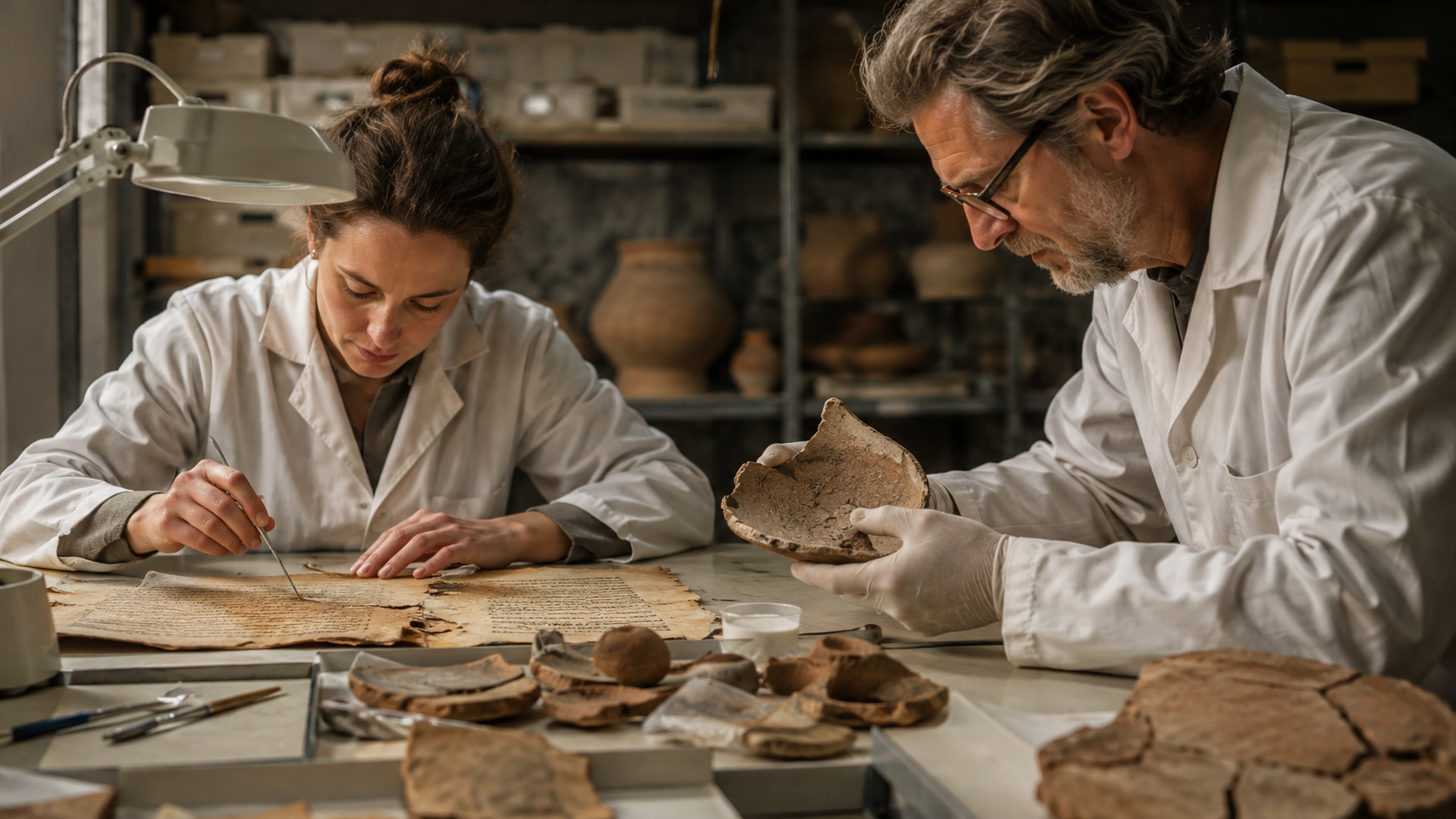
Ancient manuscripts often arrive in conservation laboratories looking silent and damaged, but modern examination can reveal a remarkable record of their creation and use. Specialists study ink, parchment, paper, stitching, stains, and repairs. Each detail helps historians understand not only what a text says, but how people handled it across centuries.
The first task is documentation. Conservators photograph every page under normal, raking, ultraviolet, and infrared light. Different wavelengths can expose erased writing, faded pigments, or sketches hidden beneath a later layer. Measurements and condition notes create a baseline so future researchers can see whether the object is stable or continuing to deteriorate.
Material analysis adds another level of evidence. Microscopes identify plant fibers in paper and hair patterns in parchment. Tiny samples, taken only when necessary, may show the minerals used in pigments or the chemical recipe of an ink. These results can connect a manuscript with a region, workshop, or historical period more accurately than handwriting alone.
Repairs also tell human stories. A page sewn together with coarse thread may show that a book remained valuable long after it left an elite library. Wax, fingerprints, smoke, and water marks suggest where it was read or stored. Notes in the margins reveal arguments, translations, prices, family records, and reactions from generations of readers.
Digital imaging allows discoveries without aggressive treatment. Multispectral cameras separate visual information that the eye sees as a single dark surface. Three-dimensional models record warped bindings, while portable scanners let teams examine collections that cannot travel. Shared databases make it possible for scholars in different countries to compare techniques and fragments.
Conservation must balance access with preservation. Flattening a page or removing an old repair can destroy evidence, so treatment is deliberately cautious and reversible. Laboratories also control light, temperature, and humidity. Ethical teams explain uncertainty clearly instead of presenting every scientific signal as proof of a dramatic attribution.
The laboratory does not replace historical interpretation; it widens the questions historians can ask. A manuscript becomes a physical witness to trade, craft, ownership, devotion, and everyday reading. By combining scientific observation with linguistic and archival research, conservators help fragile objects speak while protecting them for the next generation.
For institutions interested in manuscript conservation, the most useful first step is a small, carefully evaluated pilot. Clear goals, feedback from participants, and transparent results make it easier to improve the work before expanding it. That measured approach also helps communities direct limited time and funding toward methods that produce lasting public value.